
Aftercare for treatment plants, servicing, what JW Clark can help with afterwards… and what we can’t help with…..!
The Three Ps
With any sewerage system, including when you are connected to the public sewer, you should never be putting any waste into your system apart from Pee, Poo and Paper…..! But with a Treatment Plant in particular, if you don’t observe the Three Ps (see here) then you’re quickly going to run into trouble – and avoidable cost – with your Treatment Plant. You might have to do a bit of educating the rest of the household, including kids and teenagers in particular. They may well be used to throwing wet wipes, sanitary towels and many other prohibited items down the toilet, and it’s difficult to change habits, but if these ‘naughties’ end up in your treatment plant then it’s going to cause you trouble and cost you money. You may need to put signs up at each toilet for a period, to get people used to these basic rules.

Treatment Plant Servicing
Having had your treatment plant installed, it’s important to keep on top of maintenance and servicing. The Environment Agency requires that small sewage treatment systems are maintained and serviced in line with the manufacturer’s guidance. See the official General Binding Rules for small sewage discharges on GOV.UK for the exact duty to maintain and service your system (including keeping records): General Binding Rules – small sewage discharge to the ground.
For a plain‑English overview of good ownership and maintenance practices, DEFRA’s leaflet is also helpful: Your sewage, your environment (DEFRA leaflet, July 2015).
We don’t service Treatment Plants ourselves, but we generally recommend UK Pump Maintenance. You can also find a list of accredited service engineers on the British Water website. Or, simply do a quick Google search for a local specialist.
In between regular services done by a third party, you should also keep an eye on the plant yourself—in particular the blower (also commonly referred to as the compressor or air pump).
Your blower, whether internal (inside the treatment plant) or external (in a green hood outside the treatment plant), should be running continuously, delivering a steady stream of air into the plant.
To check that an internal blower is working, you should normally be able to hear it when stood right next to the manhole cover central to the Treatment Plant – normally black or green, and 2ft square. If you can’t hear it, then you should normally be able to feel some vibration by putting your foot on the manhole cover, or by putting your hand on it. **
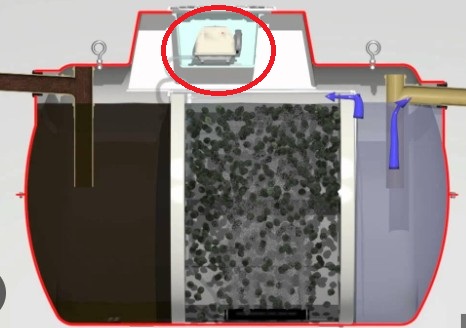
To check an external blower: place your hand on the green hood that houses the blower. You should hear/feel it working—often more obviously than an internal blower.
This ideally needs doing once a week, maybe do it on a Saturday morning, for example, or if you have a gardener or a handyman, make it their job to do it. But it’s your duty to make sure the Treatment Plant is cleaning the waste to the required standard to discharge into land drainage or into a watercourse, and if the blower isn’t working, then this is going to quickly reduce the extent to which the Treatment Plant is working effectively.
If you don’t think the blower is working, or if you can’t feel or hear it from outside, then take the main lid* off the Treatment Plant, and you should see the liquid fizzing or bubbling towards the top. If the liquid is stagnant and undisturbed, then the blower is likely not working. In the first instance, check that the electric feed to the Plant is working, consult an electrician if you need to, and if the feed is not the problem, then you will need a service engineer to attend, to fix or more likely to replace the blower.

If the blower is less than 2 years old, then it will be under warranty, in which case please get in touch with us and we’ll contact the manufacturer for a replacement, in the event that we supplied the Treatment Plant as part of our service to you.
*When taking the manhole cover off a treatment plant, never do this on your own, always have another person with you. It goes without saying, that you should never enter a Treatment Plant, this is a confined space, and every care should be taken when taking off the cover.
Pump checks
If you have a pumped outlet, the ‘pump’ is a secondary thing that you are going to have to check regularly. This is not as easy as checking the blower, as the pump for the outlet only makes a noise when the level in the plant gets to a certain point, and when the pump kicks in for a short period.
On most Treatment Plants, we will normally install a ‘final manhole’ just before the waste enters the Treatment Plant – unless you already have one in close proximity. In the bottom ‘channel’ of this manhole, the waste where it flows into the Treatment Plant should be at a minimum level where it flows through the bottom of the manhole – the ‘channel’ – nothing more than an inch or so. If it’s particularly deep, a few inches deep or more, then it’s quite likely that the effluent isn’t pumping out. You’ll need a service engineer as quick as you can get somebody out, and again, if the system is less than two years old, then speak to us, as the pump will be under warranty.

Alarms (Marsh Industries plants: MAHLA & MAHLAPS)
For Marsh Industries treatment plants we typically offer two alarm options:
- MAHLA – High‑Level Alarm
Triggers if the float switch senses a high liquid level (e.g., pump failure/blockage) and also if there’s a loss of mains power to the alarm. Includes internal battery backup so the alarm continues to operate during a power cut. - MAHLAPS – High‑Level + Loss‑of‑Air‑Pressure Alarm
As per MAHLA plus an additional pressure switch input to detect loss of compressor/air pressure (useful on aerated systems). Also monitors loss of mains power. Includes internal battery backup so the alarm continues to operate during a power cut.
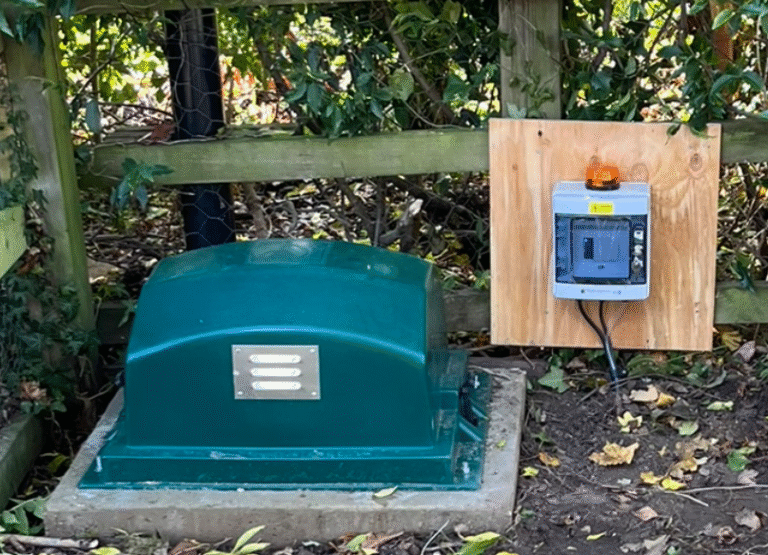
Both units provide a visual beacon and audible sounder, with a mute button to silence the sounder while the beacon keeps flashing until the fault is cleared.
Why alarms matter (especially on pumped units):
If your pump stops, the plant can fill quickly and surcharge upstream. An alarm gives you early warning before there’s a spill or backup.
A note on power dependence
These alarms are normally mains‑powered, but they contain an internal battery/UPS designed to keep the alarm active for a period during a power outage. That means they can still warn of high level even if the site has lost power.
Practical tips
- Test the alarm using the panel test/silence controls at handover and at service visits.
- Keep the float and pressure lines free from debris/kinks and mounted as per the installer’s instructions.
- If the alarm activates, treat it as urgent: reduce water use, check the electrical supply/isolator, and call a service engineer.
So to summarise, once we’ve completed your project and after we have left… we can help with:
- Replacement of blowers and pumps within 2 years of installation – but if any of these have failed, always check the electric feed first, it’s more likely to be an electrical failure in the early days than a failed part.
- Any problems relating to underground drainage pipework that we laid as part of your project
- Problems with reinstatement, i.e. ground settling around the Plant within our original excavation
We cannot help with:
- Regular servicing
- Replacement of blowers and pumps after the initial 2-year warranty has expired
- Problems with underground drainage pipework that we didn’t lay as part of your project
- Electrical problems – except whereby we instructed the electrician to make the connection to the plant and the problem is with this small amount of electrical installation, as opposed to electrics within the property as a whole – and this is usually where the problem lies.
Of all the problems we have ever encountered with Treatment Plants after we’ve fitted them, by far the vast majority of them relate to lack of servicing, in particular when blowers or pumps fail and have been left unserviceable for a long period of time. Several Treatment Plants we have fitted, have never been serviced, many years after we complete the install. We’ve seen some real horror shows over the years, whereby customers who have neglected their treatment plants end up spending many thousands of pounds just to get them serviceable again. But if you can keep on top of those regular checks as detailed above, and if you have your Treatment Plant serviced once a year, then you shouldn’t have any problems.
For a brief video explaining how a Marsh Treatment Plant works, see below