Aftercare for Pump Chambers

Aftercare for Pump Chambers, servicing, what JW Clark can help with afterwards… and what we can’t help with…..!

Aftercare for Pump Chambers

A pump chamber is used where foul or surface water drainage cannot flow by gravity and needs to be pumped uphill to connect into the public sewer or another gravity system. These systems are commonly installed on private domestic properties and, whilst reliable, they do require ongoing care and responsibility from the owner.

Once installed and commissioned, the pump chamber becomes part of the property’s private drainage system and its long-term operation sits with the homeowner.

What a Domestic Pump Chamber Does

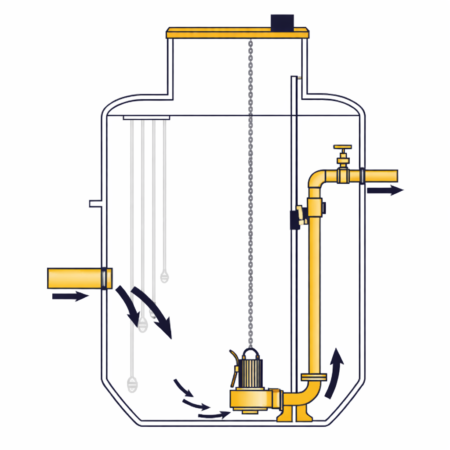
A domestic pump chamber typically consists of:

  • An underground chamber
  • One (and often two) submersible pumps
  • Float switches or level sensors
  • A non-return valve and rising main
  • An electrical control supply (sometimes with an alarm)
  • Often a ‘control panel’ at the electricity source or within a ‘kiosk’ that we fit

Wastewater flows into the chamber by gravity. When the level rises, the pump activates and pushes the water uphill through a ‘rising main’, usually an MDPE pipe, until it can discharge by gravity into the public sewer.
What Can (and Cannot) Go Into a Pump Chamber

Pump chambers are mechanical systems, not disposal units.

Only the following should enter the system:

  • Pee
  • Poo
  • Toilet paper

The following are the most common causes of pump failure and blockages:

  • Wet wipes (even “flushable” ones)
  • Sanitary products
  • Nappies
  • Fats, oils and grease
  • Excessive food waste
  • Building debris, wipes or rags

Blockages caused by misuse are not defects and are not covered by any warranty.

Owner Responsibilities After Installation

Once the pump chamber is installed and operational, the homeowner is responsible for:

Routine inspection
Periodically lifting the cover (safely) to check for abnormal smells, noises or high liquid levels.

  • Electrical supply
    Ensuring the pump remains powered. Tripped breakers or isolated supplies are a very common cause of call-outs.
  • Servicing and maintenance*
    Arranging inspection, servicing or pump replacement as required by a specialist contractor.

Pump chambers are robust, but pumps are ‘wear’ items. Over time they will require servicing* or replacement.

  1. Alarms (If Fitted)

Some domestic pump chambers are fitted with a high-level alarm, and we highly recommend these for Pump Chambers in particular. On the majority that we fit, a beacon on the ‘control panel’ or on the outdoor kiosk will flash in the event of a problem.

If an alarm sounds:

  • Try to reduce usage immediately, if you can
  • Check the electrical supply, primarily any ‘trip switch’ on the internal fuseboard for the house
  • Contact a specialist pump engineer* if the issue does not resolve itself

An alarm indicates rising water levels and should never be ignored, as continued use can lead to flooding or pump burnout.

  1. What JW Clark Will Support After Installation

Within two years of installation, JW Clark will assist with:

  • Replacement of pumps supplied and installed by us, if they fail due to manufacturing defect
  • Issues relating to pipework we have installed
  • Ground settlement or reinstatement issues directly linked to our works**
  1. What JW Clark Does Not Cover

JW Clark does not provide and are not responsible for:

  • Routine servicing or maintenance
  • Emergency pump call-outs
  • Replacement of pumps outside the warranty period
  • Repairs caused by misuse, blockages or lack of maintenance
  • Electrical faults beyond the original connection made to the chamber
  • Electrical faults relating to the electrical installation, whereby we did not appoint the electrician
  • Repairs to pipework not installed by us
  • **Ground settlement relating to where an old septic tank, or similar, has has been filled with inert material

*For ongoing care, homeowners should appoint a pump maintenance specialist. We recommend UK Pump Maintenance (https://www.ukpumpmaintenance.com/) for servicing, maintenance and emergency support of domestic pump chambers.

  1. Why Maintenance Matters

Most pump failures are not sudden — they are the result of:

  • Gradual wear
  • Blockages from unsuitable materials
  • Electrical isolation or neglect

Simple checks and occasional servicing can significantly extend the life of the pump and avoid costly emergency failures.

**In the event that we fill an old septic tank with inert material, it is not possible for us to compact any ‘fill’ that we put inside the tank. Therefore, further settlement is to be expected later on. For this reason we always suggest retaining the manhole cover on top of the old septic tank, in order that any settlement is covered. In the event that we remove the manhole cover and reinstate a grass area on top of an old septic tank, settlement of the fill will be noticeable in time, and JW Clark cannot be responsible for returning to site to keep filling settled ground. Should you wish for an old septic tank to filled and for there to be no future settlement, the tank must be filled with concrete instead. This will add significant further cost to our original quote. 

In Summary

A domestic pump chamber is a reliable solution where gravity drainage is not possible, but it is not maintenance-free. Understanding how it works, using it correctly, and responding promptly to issues will ensure long-term, trouble-free operation.

Any more questions, please don’t hesitate to ask!

For many years, at JW Clark Ltd, we have installed only Pump Chambers manufactured by Marsh Industries. All Pump Chambers are made-to-order, based on the distance to be pumped, the ‘lift’ and the size of house and number of bedrooms and likely number of inhabitants. See video below for more information on Marsh Industries Pump Chambers.

Do you have a project you wish to discuss?

Lorem ipsum dolor sit amet, consectetur adipiscing elit. Ut elit tellus, luctus nec ullamcorper mattis, pulvinar dapibus leo.

Lorem ipsum dolor sit amet, consectetur adipiscing elit. Ut elit tellus, luctus nec ullamcorper mattis, pulvinar dapibus leo.

How much does a new sewer connection cost?


Example costs from previous projects (illustrative only)

To give a clearer idea of how costs can vary in the real world, below are examples from previously quoted projects. These are not fixed prices and should be taken as indicative only — each job is priced on its own constraints, permissions, and risks.

They do, however, demonstrate how factors such as depth, road crossings, traffic management, and length of run can dramatically affect the final cost.

Example 1: Simple highway connection (shallower depth)

  • Sewer on the same side of the road as the property being connected 
  • Approx. 1.0m deep
  • Works carried out in the highway
  • 2-way temporary traffic lights
  • Short connection distance

Typical cost range:
£7,000 – £9,000

This is about as straightforward as a highway sewer connection gets. Limited depth, minimal excavation risk, and standard traffic management keep costs relatively controlled.

Example 2: Crossing the road at greater depth

  • Sewer on the opposite side of the road
  • Approx. 2.0m deep
  • Full road crossing required
  • “Give & take” traffic management
  • Increased excavation and reinstatement

Typical cost:
£11,000-£14,000

Crossing the carriageway immediately adds time and complexity, even before depth is considered. Deeper excavations require more robust trench support and stricter safety controls.

Example 3: Deeper excavation with more complex traffic management

  • Sewer on the same side of the road
  • Approx. 3.0m deep
  • Highway works
  • 3-way traffic lights (e.g. near a junction)

Typical cost:
~£14,000-£17,000

At this depth, excavation becomes significantly more involved. Temporary works, additional plant, longer programme, and more complex traffic control all contribute to the increase.

Example 4: Very deep sewer in the centre of the road

  • Sewer located in the middle of the carriageway
  • Approx. 6.0m deep
  • Major excavation with engineered temporary works
  • Full road closure & diversion required
  • Extended programme and high H&S input

Typical cost:
~£25,000-£35,000

This type of work carries substantial risk and regulatory oversight. Deep excavations in live highways are slow, methodical, and safety-led — which is reflected in the cost.

Example 5: Long sewer run with multiple manholes

  • Approx. 110 metres of new sewer pipework laid along the road
  • 3 new manholes constructed
  • Extensive highway works, Full road closure & diversion required
  •  
  • Multiple permits, inspections, and phased traffic management

Typical cost:
~£130,000+

This is effectively a small infrastructure project, not a simple connection. Length of run, number of chambers, reinstatement, and prolonged traffic management all combine to push costs significantly higher.


Summary: Why sewer connection costs vary so widely

When we are asked, “How much does a new sewer connection cost?”, the most accurate answer is that it depends on a combination of permissions, risk, depth, distance, and working environment. Even two connections on the same street can differ dramatically in price once the constraints are understood.

The cost of any sewer connection is made up of four main elements. First are Water Authority or Sewerage Undertaker charges, which cover applications, technical approvals, inspections, and in some cases the final connection itself. These charges are not standardised across the UK; each water company publishes its own charging arrangements, meaning costs can vary significantly from one area to another.

Second are Highways Authority costs, which apply when any part of the works takes place in the public highway. These include permits or licences, compliance with the local authority’s permit scheme, and any conditions imposed on how and when the works can be carried out. Highway involvement almost always increases both cost and programme length.

Third is the groundworks and civils element, and of course this is one of the biggest determining factors. This includes the physical construction work itself: excavation, sheeting & making the excavation safe, pipe installation, backfilling, and reinstatement. This is where site-specific risks have the biggest influence on price.

Finally, there is traffic management, which is often one of the largest and most underestimated cost drivers. Requirements can range from simple ‘give & take’ traffic management, through to temporary 2-way traffic lights, multi-way lights, and full road closures with diversion routes, which are unfortunately becoming more common, as Highways authorities take more and more of an interest in the Health & Safey aspect of works carried out in the Highway – Imagine the increased risk factor of our operatives working only a metre or so away from fast-moving traffic, with only plastic barriers to protect them, compared to a full road closure, where there is of course no risk from traffic at all.

One of the biggest factors affecting cost is whether the connection is on private land or in the public highway. Works on private land are generally quicker and simpler, with fewer third-party constraints. Highway works involve more regulation, tighter working windows, higher safety standards, and stricter reinstatement requirements.

Depth of the sewer is another major driver. As excavation depth increases, so does complexity. Deeper excavations require trench support or engineered temporary works, more plant, increased supervision, and more stringent health and safety controls. The risk of groundwater and unstable ground conditions also rises with depth, all of which pushes cost.

Distance from the property to the point of connection is a straightforward but important factor. Longer runs mean more excavation, more pipework, more reinstatement, and more time on site. They also increase the likelihood of encountering existing services or obstructions.

And on the subject of services, what’s already in the ground can have a major impact. Gas, water, electricity, fibre, telecoms, old ducts, chambers, and previous reinstatements all influence how quickly the work can be carried out. Discovering services that we weren’t expecting, can force changes to excavation methods, traffic management, and programme, sometimes at very short notice.

Road type and traffic conditions also matter. A quiet residential road may allow simpler traffic control, while a main road, bus route, or junction can trigger complex traffic management, restricted working hours, and often road closures. These requirements are often dictated by the Highway Authority rather than the contractor.

Reinstatement is another commonly underestimated element. Highway reinstatement must meet strict specifications for materials, compaction, and finish. This can include multiple layers of surfacing, kerbs, footways, tactile paving, and specialist finishes, all of which add labour and material cost.

The key takeaway is simple: there is no such thing as a standard sewer connection price. A proper quote must account for depth, distance, permissions, traffic management, ground conditions, and authority requirements. Contractors who do not ask detailed questions at the outset are either guessing or excluding items that will appear later as variations.

Do you have a project you wish to discuss?