

If your property has a septic tank, you may assume that regular emptying will keep the system working indefinitely. Unfortunately, this isn’t always the case.
Although a septic tank can last for decades, the soakaway—also known as a drainage field—receiving its wastewater will eventually become blocked and stop working.
The terms ‘soakaway’ and ‘drainage field’ are often used interchangeably. However, a conventional rainwater soakaway is generally unsuitable for wastewater from a septic tank or treatment plant. Discharges to ground should use a properly designed drainage field.
Many older installations also fail to meet current environmental requirements, particularly where septic tank effluent enters a watercourse directly or through an ineffective drainage arrangement.
Here we explain why these systems fail, how long they last and when replacement may be necessary.
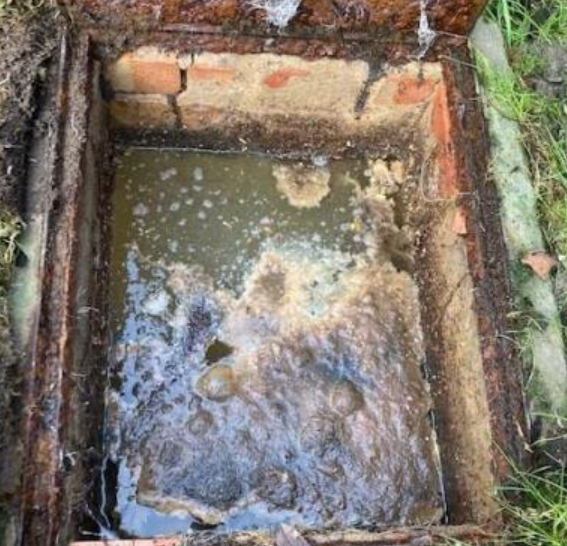
What does a septic tank soakaway do?
A septic tank separates solids from household wastewater.
Heavier solids settle at the bottom, while fats and grease accumulate near the surface. The partially treated liquid, known as effluent, flows into the surrounding drainage system.
In older installations, this may be a traditional rubble-filled soakaway, where wastewater gradually filters into the ground.
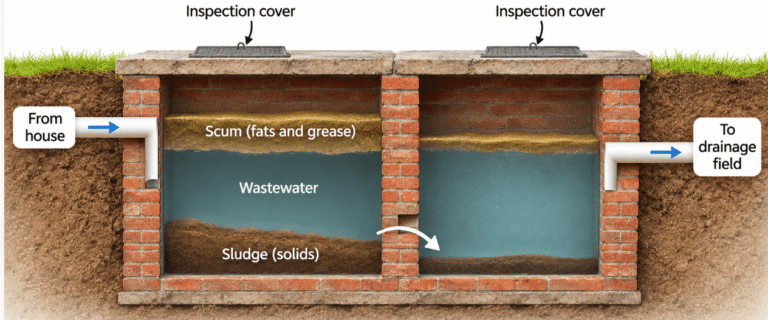
Above: An example of how an old Victorian septic tank was built – and many are still in existence today
However, the liquid leaving a septic tank is not clean water. It still contains organic matter, fine particles, bacteria and other contaminants.
Over time, these substances can cause the soakaway and surrounding soil to become blocked.
Why do septic tank soakaways eventually fail?
One principal cause is the gradual accumulation of organic material within the ground receiving the wastewater.
As effluent enters the soil, microorganisms develop a biological layer known as a biomat.
This is a natural part of the treatment process, helping remove contaminants from the wastewater.
However, as the biomat thickens, it can restrict the rate at which water passes into the surrounding ground.
Fine solids and grease escaping from the septic tank can make matters worse. Eventually, the ground may become unable to absorb wastewater quickly enough, causing the drainage system to back up or overflow.
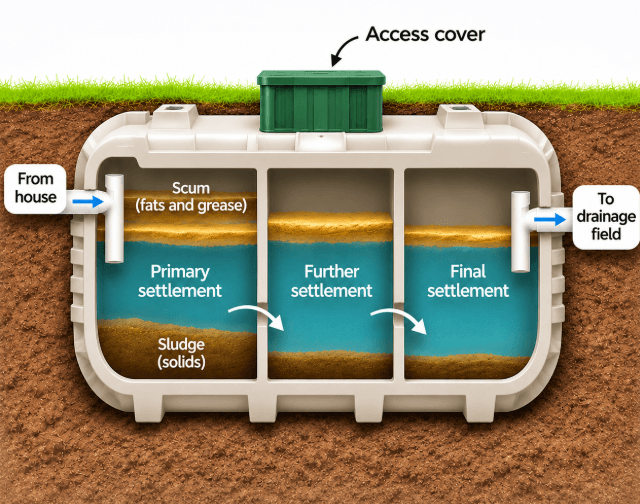
Above: Even in a modern-day septic tank, the design principle and the quality of separation are very basic
How many years should a septic tank soakaway last?
There is no fixed lifespan.
Some soakaways function for decades, while others develop problems much sooner.
Their lifespan depends on:
- Ground conditions: Heavy clay absorbs wastewater less readily than suitable free-draining soils.
- System size: Undersized soakaways can become overloaded.
- Usage: More occupants produce more wastewater.
- Maintenance: Poorly maintained tanks can allow solids into the drainage system.
- Groundwater: High groundwater levels can prevent effective drainage.
- Construction: Older installations may be poorly designed or unsuitable for their intended purpose.
What are the warning signs of a failing soakaway?
Common indications include:
- Wastewater backing up into drains or the septic tank.
- Toilets, sinks and baths draining slowly.
- Wet or unusually green ground around the soakaway.
- Unpleasant sewage smells.
- Wastewater appearing at ground level.
- Problems becoming worse during wet weather.
These symptoms can also result from blocked or damaged drainage pipes, so investigation is advisable before replacing the system.
Are septic tank soakaways still legal?
Traditional soakaways are not generally an acceptable means of disposing of septic tank effluent under current regulations in England.
An important distinction exists between a conventional soakaway and a properly designed drainage field.
Traditional soakaways are typically intended for rainwater disposal, whereas drainage fields are designed to distribute partially treated sewage effluent through suitable soil, allowing further treatment.
Modern drainage fields use perforated pipes laid in specially designed trenches, spreading wastewater over a larger area.
Under the Environment Agency’s general binding rules, septic tanks discharging to ground must use a suitable drainage field or infiltration system.
A compliant septic tank and drainage field can still be lawful. However, many older properties have drainage arrangements that may not satisfy these requirements.
The fact that an old septic tank system has operated for decades does not automatically mean it complies with current regulations.
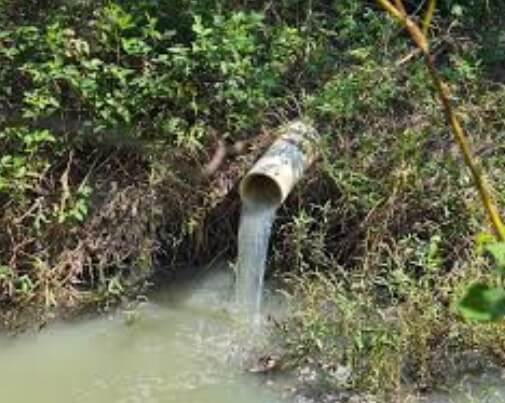
Can a septic tank discharge into a stream or ditch?
No. Since 1 January 2020, septic tanks in England have not been permitted to discharge directly into watercourses, including streams, rivers and ditches.
Older systems operating in this way must be upgraded or replaced with a compliant arrangement.
A modern package sewage treatment plant treats wastewater to a higher standard and may discharge into a suitable watercourse, provided the relevant environmental requirements are satisfied.
Alternatively, a compliant drainage field or connection to the public sewer may be appropriate.
Can an old septic tank cause problems when selling a house?
Yes, definitely. A non-compliant septic tank or soakaway can create considerable difficulties when selling a property.
During conveyancing, purchasers and their solicitors may investigate the property’s drainage arrangements and whether they comply with current environmental regulations.
If an older septic tank discharges into an unsuitable soakaway or directly into a watercourse, the buyer may be concerned about the cost of bringing the system into compliance.
This can result in:
- Buyers requesting further drainage investigations.
- Negotiations over the cost of replacement works.
- Requests for the seller to upgrade the system before completion.
- Delays to the sale.
- Buyers reducing their offers or withdrawing altogether.
Property sellers must also provide the purchaser with written information about the private sewage system and its maintenance requirements.
Consequently, a septic tank system that appears to be working satisfactorily can still become an expensive problem when the property is marketed.
Related fact sheet: Are Septic Tanks Illegal? — Read our guide to current septic tank regulations and the implications for property owners.
Is a modern drainage field a permanent solution?
Not necessarily.
Although properly designed drainage fields are preferable to traditional soakaways, they can still deteriorate through biological clogging, excessive solids or overloading.
They also require suitable ground conditions, sufficient land and appropriate separation from groundwater.
Where these requirements cannot be met, alternative drainage arrangements may be necessary.
What should I do if my soakaway is failing or non-compliant?
There are three main options worth investigating.
- Install a replacement drainage field
Where suitable land and ground conditions exist, a compliant drainage field may be installed.
- Install a package sewage treatment plant Click here for more info
Where a suitable watercourse is available, a treatment plant may provide an alternative, subject to environmental requirements and any necessary permissions. A sewage treatment plant requires ongoing servicing and maintenance. Read our treatment care aftercare guide to understand what’s involved
- Connect to the public sewer Click here for more info
Where a public foul sewer is reasonably accessible, connecting to mains drainage can eliminate the need for an on-site sewage treatment and disposal system. In fact – where there is a public sewer within 30 metres of your boundary, you are legally obliged to connect to it, you cannot fit a new septic tank or treatment plant.
The most appropriate option depends on location, ground conditions, available space and cost.
Can JW Clark help?
JW Clark Ltd undertakes groundwork, drainage and public sewer connection works, including projects involving existing private drainage systems.
Established in 2004, we have extensive experience of underground drainage installations.
If your existing soakaway is failing, or you’re concerned about whether your septic tank arrangement complies with current regulations, we can help investigate practical alternatives.
These may include replacement drainage arrangements or connecting your property to the public sewer.
Contact JW Clark Ltd to discuss your property and the options available.
Find out more about our drainage and sewer connection services
Need a sewer connection within the public highway?
If your proposed sewer connection involves excavating a road or footpath, JW Clark can help you understand the permissions, practical requirements and likely costs.
Contact JW Clark Ltd to discuss your project or request a quotation.
