One of the most common questions we are asked at JW Clark Ltd in relation to Treatment Plants is:
Does a Treatment Plant Have to Be Surrounded in Concrete?
Not always — but in most cases, surrounding a treatment plant in concrete is the safest long-term option.
At JW Clark Ltd we are Marsh Industries Approved Installers, and our policy is to surround treatment plants in concrete every time. No ifs, no buts.

Most domestic and commercial treatment plants are manufactured from GRP (glass-reinforced plastic). The manufacturer’s installation instructions will normally state that the unit should be surrounded in either gravel or concrete, depending on the ground conditions.
That sounds straightforward. The problem is that ground conditions can change, and they often do.
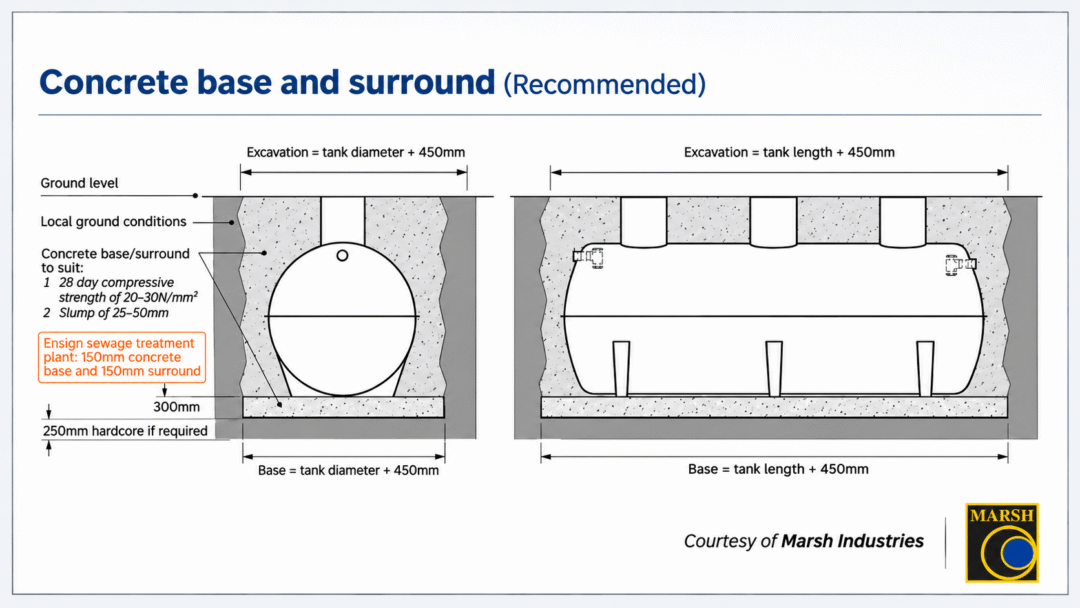
See below, from Marsh Industries website, detailing how concrete should be formed below and around a Treatment Plant
Dry Ground Today Does Not Mean Dry Ground Forever
A treatment plant may be installed in apparently dry, stable ground, with no obvious groundwater present.
However, ground that is completely dry during the summer months can become saturated during wetter months of the year, as rainfall increases and groundwater levels rise. An excavation that is perfectly dry in July may contain significant groundwater in January.
Even if the ground remains dry throughout the year, that does not guarantee it will stay that way in the future.
A year, five years or ten years later, conditions around the treatment plant could be completely different. For example:
- A nearby water main or service pipe could begin leaking, and continue to leak over a long period of time, saturating the ground long term.
- A new housing or commercial development could alter local drainage patterns.
- New roads, paving or buildings, where sometimes ancient land drainage pipes are disrupted or damaged, can push surface water towards the area of the treatment plant.
- Groundwater levels can rise following prolonged periods of exceptionally wet weather.
- Drainage works on neighbouring land can unintentionally redirect water underground towards the area.
Once water starts building up around a GRP treatment plant, the forces involved can be enormous.
We Have Seen What Can Happen
We have previously attended a site where a large 50-person treatment plant had effectively floated out of the ground.
The scene looked almost apocalyptic.
Tonnes of soil and excavated material that had originally been holding the installation down had been pushed to one side. And the huge treatment plant itself was sitting in a huge body of water, literally floating, having been forced upwards by the volume of groundwater.
It demonstrates just how powerful groundwater pressure can be.
A treatment plant may look heavy and substantial, but compared with the buoyancy created by several tonnes of water underneath, an empty or partially empty GRP tank can behave surprisingly like a boat! And problems often occur when the plant is emptied, when the weight of the plant is reduced significantly.
This is one reason why the correct installation and ongoing maintenance of a treatment plant are so important. For further guidance on looking after a treatment plant once installed, see our factsheet: Aftercare for Treatment Plants.
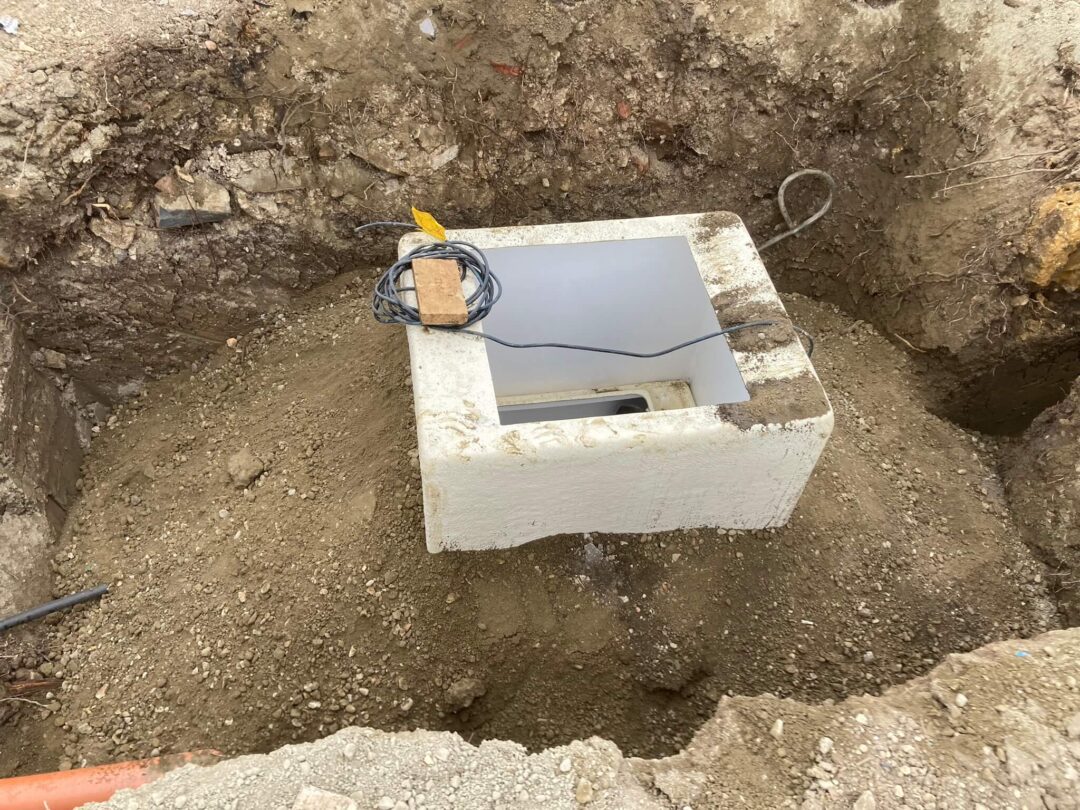
Above: Concrete base ready for a treatment plant to be lowered in on top.
Why Do Some Installers Avoid Concrete?
One obvious reason is cost.
The volume and weight of concrete required to install a treatment plant properly can be considerable.
Even a relatively small 6-person treatment plant can require up to around 15 tonnes of concrete, depending on the plant, excavation and installation requirements.
That means additional:
- Concrete cost
- Labour
- Pumping or placement costs
- Extra excavation
- Spoil removal
- Time on site
There is therefore an obvious temptation to save money by surrounding the treatment plant with gravel.
Unfortunately, some installations go further still, with unsuitable inert material simply tipped around the tank.
That may save money during installation, but it can create a far more expensive problem later.
The cost of the concrete surround is just one element of the overall installation. We explain the various costs involved in more detail in our factsheet: How Much Does a Sewage Treatment Plant Cost, Including Installation?.