
Who Can Legally Carry Out a Sewer Connection in a Public Road?
If you’re building a new property and arranging a connection to the public sewer, or if you’re trying to get off a septic tank and onto the public sewer, you’ll likely discover that the existing sewer is located in the Highway somewhere. It will most likely be under the road, and often very deep – click here to read about how deep public sewers are.
Although many groundwork contractors can install all manner of underground drainage, not every contractor is suitably qualified or authorised to undertake sewer connection works within the public highway. It can be quite a specialist job.
There are specific legal requirements, permissions and qualifications that must be in place before work can begin.
Do you need a specialist sewer connection contractor?
In practice, yes.
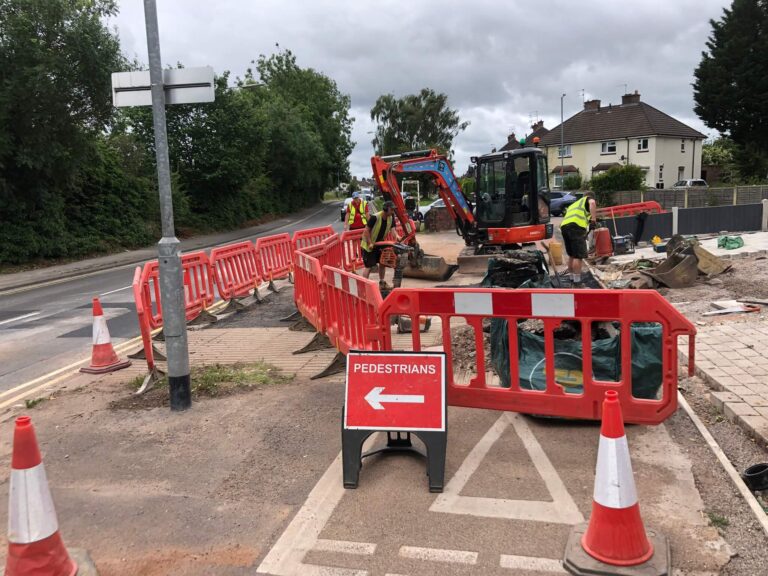
Connecting to a public sewer beneath a road normally involves excavating the highway, exposing the existing sewer, installing the connection and reinstating the road afterwards.
These operations are governed by street works legislation and the requirements of the relevant water authority.
The contractor must have appropriately qualified personnel, suitable insurance and the necessary permissions.
Simply employing a general builder or groundworker will often not automatically satisfy these requirements.
What is a Section 50 licence?
Under the New Roads and Street Works Act 1991, a Section 50 licence allows a person or organisation without statutory street works powers to carry out specified works within the public highway.
For a private sewer connection, a Section 50 licence will normally be required from the local highway authority.
The licence sets out conditions relating to matters such as:
- Excavation and reinstatement of the highway.
- Traffic management and pedestrian safety. Read about the cost of closing the road for a sewer connection
- Working dates and permitted hours.
- Insurance and safety requirements.
A contractor cannot simply excavate a public road because a customer has instructed them to connect to a sewer.
Importantly, a Section 50 licence is separate from the water authority’s permission to connect to the public sewer.
Click here to read more about Section 50 Licences
What qualifications must the contractor have?
Under Section 67 of the New Roads and Street Works Act 1991, street works must generally be supervised by someone holding the appropriate Street Works supervisor qualification.
There must also be at least one appropriately qualified operative on site whenever the relevant street works are being undertaken.
These are commonly referred to as NRSWA qualifications.
They cover activities including:
- Locating and avoiding underground services.
- Setting out signs, lights and barriers.
- Excavation within the highway.
- Reinstatement of roads and footpaths.
- Supervision of street works.
The precise qualifications required depend on the activities being undertaken.
See how we managed highway permissions, a road closure and resident access on our Bourne End sewer connection project
Does the water authority also need to approve the connection?
Yes. Always. It’s their network and nobody can work on it without their say-so.
Before connecting to a public sewer, approval will normally be required from the relevant water authority under Section 106 of the Water Industry Act 1991.
Anglian Water, Severn Trent and Thames Water each have procedures governing connections to their sewer networks. These are the networks we generally work on, at JW Clark Ltd
Depending on the authority and proposed connection, the contractor may need to demonstrate:
- Relevant experience and competence.
- Suitable public liability insurance.
- Appropriate health and safety arrangements.
- Necessary training and qualifications.
- Acceptable methods of working.
The water authority will normally specify the permitted connection method and require inspections.
Section 106 approval does not automatically authorise excavation within the public highway. The highway and water authority requirements must both be satisfied.
Click here to read more about Section 106 applications to a water authority
What insurance is required?
Sewer connections within public roads can involve substantial risks, including damage to underground utilities, injury to road users and defective highway reinstatement.
Highway authorities normally require evidence of adequate public liability insurance before granting a Section 50 licence.
Requirements vary, although a higher level of insurance at £10 million of public liability cover is commonly specified.
The water authority may impose additional insurance requirements.
Customers should ensure their contractor has suitable insurance for the proposed works.
Can a homeowner carry out their own sewer connection?
A homeowner cannot simply dig up a public road and connect to the sewer themselves.
Although Section 50 licences can be granted to individuals or organisations without statutory street works powers, the appropriate permissions, qualifications, insurance and safety arrangements must still be in place.
For most homeowners and small developers, employing an experienced sewer connection contractor is the only option.
What happens if work is undertaken without permission?
Carrying out street works without the necessary authority can result in enforcement action and potentially prosecution.
Unauthorised sewer connections may also require remedial work or retrospective action by the relevant water authority.
Defective highway reinstatement can lead to additional inspections, repair costs and other consequences.
These are important reasons for ensuring that the contractor is properly authorised and suitably qualified before commencing work.
What should I ask a sewer connection contractor?
Before appointing a contractor to work within the public highway, establish the following:
- Section 50: Who will arrange the highway licence?
- Qualifications: Are appropriately qualified NRSWA operatives and supervisors available?
- Section 106: Who will obtain the water authority’s approval?
- Insurance: Does the contractor have adequate public liability cover?
- Experience: Has the contractor previously undertaken sewer connections within public roads?
- Traffic management: Who will arrange temporary traffic lights or a road closure if required?
- Inspections: Who will arrange inspections and final sign-off?
An experienced contractor should be able to explain these responsibilities clearly.
Can JW Clark Ltd undertake sewer connections within public roads?
Yes, that’s what we do, and we’ve been doing it for over 20 years. JW Clark Ltd is an established groundwork and civil engineering contractor, with extensive experience of undertaking public sewer connections, including installations requiring excavation within the public highway.
Established in 2004, we regularly deal with the practical and administrative requirements associated with these works.
Our services can include Section 106 applications, Section 50 highway licences, traffic management, excavation, installation, reinstatement and arranging the necessary inspections.
We undertake sewer connection projects across areas served by Anglian Water, Severn Trent and Thames Water.
Need a sewer connection within the public highway?
If your proposed sewer connection involves excavating a road or footpath, JW Clark can help you understand the permissions, practical requirements and likely costs. Read our guide to how much a new sewer connection costs
Contact JW Clark Ltd to discuss your project or request a quotation.


 By JWC